
WHAT IS POOL WINTERIZATION AND WHAT DOES IT INVOLVE? DIFFERENCES, ADVANTAGES AND MOST IMPORTANTLY, GREAT COST SAVINGS.
The summer season has come to an end and cooler weather is becoming the norm. It’s a good time to start what’s known as winterizing the pool.
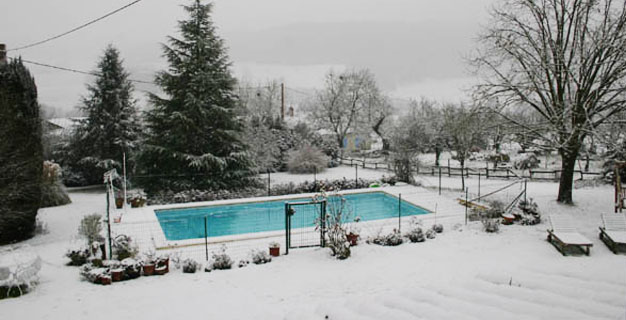 WHAT IS WINTERING AND HOW IS IT APPLIED?
Winterizing involves preparing our facilities and applying products to the pool to preserve its properties and reduce maintenance and start-up costs for the following season. There are two important advantages: firstly, by preparing our facilities, we protect them from the risks of winter and inactivity; and secondly, in these times, water is a scarce resource that we shouldn’t waste.
DISTINGUISH TWO CASES:
1. In this case, we will drain the pool and completely replace the water. If we do not have a pool cover, we may decide to limit the winterizing process to adding chemicals and leaving the pool completely inactive.
Even in this case, the significant savings in cleaning and descaling our installation at the beginning of the next season justifies the winterization process.
It is important that we provide a water sample to our trusted professional for water analysis, at least once a year, so that they can detect if the water is saturated with byproducts and, if necessary, renew it.
2. The case where the water has received the necessary care and will be fully recovered at the start of the next season. This is clearly the most environmentally friendly option, and its added advantages are obvious. In this case, a pool cover will facilitate our goal.
DO NOT LEAVE THE POOL EMPTY
An empty swimming pool becomes weak under the pressure exerted by the surrounding earth. The water inside the pool counteracts this pressure, effectively canceling it out. Therefore, keeping the pool full prevents cracks from forming in the walls. Furthermore, the water itself acts as an insulator, making the walls less susceptible to the elements and dirt.
Additionally, if we have a pool cover, we will prevent the water from being so exposed to dirt, wind, and the cold of winter.
For these reasons, the pool should be kept full during the winter period, and to minimize the negative effects, we must proceed with winterizing it.
ADVANTAGES OF WINTERING
1. It’s simple and cheap
2. We will keep the water in ideal conditions, reducing subsequent maintenance and start-up costs.
3. Recover all the water from one season for the next. Water is becoming an increasingly scarce resource, making it a very precious commodity.
4. We will avoid the presence of annoying insects that could otherwise proliferate in it.
5. The facilities will be kept in perfect condition.
6. Clean and pleasant appearance all year round.
7. To some extent, swimming pools are safer because we can see them in their full depth all year round.
8. We will achieve significant savings, both in labor and money.
START AND END OF WINTERING
Winterizing lasts approximately six months, and depending on the area, it should begin after the summer season ends. Each pool has a suitable date to begin winterizing, and in no case, even after the process has begun, should we neglect water maintenance until the average water temperature has dropped below 15ºC.
STEPS FOR PROPER WINTERING
1. Thoroughly clean the pool.
2. Backwash the filter.
3. Adjust the pH of the pool between 7.0 and 7.2.
4. Perform a shock chlorination with the pump running to prevent any small impurities in the water from becoming overwintered. To avoid discoloration of the pool liner, use a float valve or add the active chlorine directly to the skimmers. Allow the chlorine to work for at least 5 hours before proceeding to the next step.
5. With the pool filter running, add the winterizing product at the indicated dose. Make sure to distribute it throughout the pool.
6. To prevent the level from rising due to rain, it is sometimes recommended to lower the water level, although it is important not to reduce it below the skimmer window.
7. Immobilize the water in your pool by closing the water injectors and drains.
8. Protect the pump(s) of the water treatment plant by covering them with insulating material. It is advisable to take measures, if necessary, to prevent frost damage to the pipes of your system, draining them where possible.
9. If you have automatic pool cleaners that stay in the water, it is advisable to take them out of the water.
10. Add some floats (for example, empty chemical drums with air inside) which will prevent ice formation in case of frost by moving on the water, and in the extreme case that it forms, will decrease the water pressure on the walls of the pool.
11. If you have a pool cover, it is recommended to cover the pool to prevent the accumulation of leaves and dirt.
12. Finally, remember that the winterizing agent should be applied twice during the season , at the beginning and between the months of January and February, depending on the weather conditions.
WINTERING MONITORING
Although following the winterizing process can be considered complete, it’s advisable to regularly check the pool’s condition. The guidelines aren’t exact, and regularity isn’t critical. For example, you could perform the following tasks every 2-3 weeks:
1. We will start the pool filter with the selector valve in the filtration position for about 2 or 3 hours. If we have followed steps 7, 8, and 9 of the winterizing process, we must take this into account. If we have covered the pool, it is not necessary to remove the cover. This process, in addition to being very beneficial for the water, will prevent possible blockages of the filter pump at the beginning of the next season.
2. If we do not have a cover, it is advisable to remove larger objects with a leaf skimmer and take advantage of one of the previous filtration cycles to use the pool cleaner .
3. It is very important that during the month of January or February we must proceed with the second application of the winterizing agent .
4. In the spring months we must be very alert in case the temperature increases above 15ºC on average, because it is at this time that we must start the usual summer weather treatment.
THREE WAYS TO WINTERIZE A SWIMMING POOL
CHLORINE TREATMENT
This system involves maintaining the pool with multi-action chlorine using a floating dispenser with a special solution that slowly releases the chlorine . The effect is similar to the summer treatment, but with a much longer-lasting effect. The pH and chlorine levels will still need to be maintained , but without the fluctuations caused by summer heat and swimmers.
COMBINED TREATMENT
The most widely used method is also the most environmentally friendly , as it allows us to reuse the water for the following summer season , depending on the levels of cyanuric acid we have maintained. The treatment involves adding winterizing products in addition to chlorine, which do not contribute cyanuric acid, a residue whose concentration in the water must be monitored.
In some cases, these winterizing products require the temperature to be below 15ºC.
STOP TREATMENT
Used in very cold areas with a real risk of severe frost . This winterizing product prevents algae growth. This makes it easier to drain and clean the pool when it’s time to open it. To prepare, keep the water level below the skimmers, stop the filtration system, and drain the water from the pump, filter, and filter housing. In this case, since there is no backup filtration system, you will have to wait until the water temperature is below 15ºC before starting the treatment.
For other water treatment options, click on the following link: Water Treatment
For any questions or concerns, you can contact us through our Facebook page.